Sunday, July 18, 2010

Week 31: Jerusalem


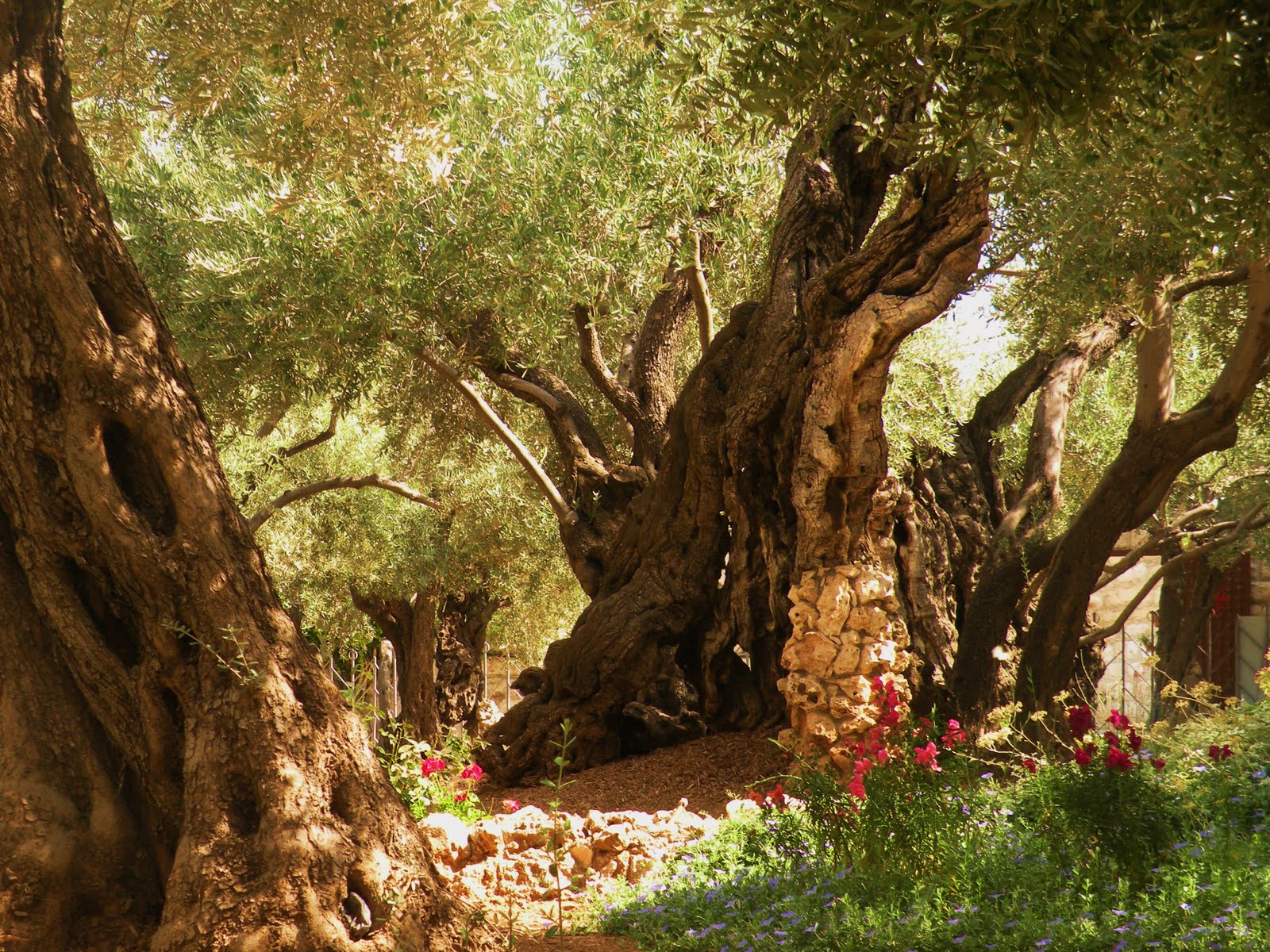
At Gethsemane a small grove of olive trees have been preserved with some, like the one featured here, now over 2,000 years old. This tree may well have known Jesus, as he prayed for guidance at this place prior to giving himself up for arrest and crucifixion. It has seen the passage of time from Roman rule, to the Byzantinian period, thru the Crusades, to Islamic rule and the Turkish Empire, thru the British, Jordanian, and Israeli rulers of the past 100 years.

For me this tree in the olive grove next to Church of Gethsemane has a spiritual significance beyond any other location Kris and I visited in Jerusalem during our seven days there. Sites holy to Judaism, Christianity, and Islam are present throughout Old Jerusalem, as well as just outside the historic city walls. There is the Dome of the Rock (where Abraham is said to have been willing to sacrifice his son about 4,000 years ago), the Western Wall (what remains of the Second Jewish Temple, destroyed by the Romans in AD 70), the Church of the Holy Sepulchre (built on the location where tradition says Jesus was both crucified and was buried), and the Al-Aqsa Mosque (the third most holy place in Islam, after Mecca and Medina -- nearby the Dome of the Rock where Mohamed is believed to have been raised into heaven). Kris and I visited these places and many more, especially sites associated with Jesus` Stations of the Cross and his mother Mary (who, according to Orthodox Christians, has her remains at Mary`s Tomb). While the historical accuracy of many locations is questionable (the site said to be where the Last Supper occurred was located just above King David`s Tomb), the faith of believers is very real.

Sadly, this faith has made Jerusalem a battleground for centuries, with soldiers on the streets of the Old City even today. As told by excellent displays at the Museum at David`s Tower, Jerusalem has been destroyed six times and rebuilt seven. The blood of the innocent is everywhere -- shed, for example, by Christian Crusaders who conquered the city and slaughtered every Jewish and Muslim man, woman, and child while celebrating their victory. No such extreme brutality has been ever been manifest under either Islamic or Jewish rule. What might Jesus (with his message of suffering love) have to say about that? If we take a little time to ask the old olive tree, I think we can hear an answer....

Today over 80% of Old Jerusalem (within the walls) is Palestinian Muslim, with Jewish immigrants forming a majority of the population in the areas of the city built since the 1860s. These Muslims, as well as those residing in East Jerusalem, are in territory occupied militarily by Israel since the 1967 War. No nation (other than Israel) recognizes this occupation as legal under international law (though both major parties in the U.S. consistently support it with military aid that has now reached record levels). Soldiers armed with automatic rifles are stationed throughout the Old City, but not elsewhere in Jerusalem: Here the Muslims are seen as an ongoing security threat. Although they were allowed to remain after the 1967 War (and were even given Israel citizenship), not one Muslim I spoke with on the streets will vote, and all call themselves Palestinian (not Israeli).

Zahir, our Muslim guide while visiting Mt. Moriah (The Temple Mount which includes the Western Wall and Al Aqsa Mosque), showed us the bullet holes in the Dome of the Rock (sacred to all three religions) made as Israeli soldiers entered the holy place in 1967 killing many who had taken refuge there. With our own eyes Kris and I then observed armed Israeli soldiers enter the Dome (now a mosque), completely violating its sanctuary even now. Witnessing this intrusion, Zahir went on to tell us how he, as a Muslim of under 50 years of age, is not allowed to worship inside Dome. Prior to the year 2000, Muslim policy allowed Christians and Jews to freely enter this site that is sacred also to their faiths. Israeli state policy now limits entry to the Dome by anyone they choose to exclude, including all tourists, Christians, and Jews. Any complaint can lead to arrest and detention without trial.

Random conversations with Israeli soldiers and many others continue to blame such policies on security concerns caused by terrorism. They often see Zionism (which requires Israel to be a majority Jewish state with its capital a united Jerusalem) as the only protection against an historically hostile world. I am reminded of an aspiring actor on a bus who told Kris and I that even the United Nations supports the terrorists. This otherwise very rational person would agree with the man I talked to while he played with his dog: ``the entire world is critical of us, and the whole world is wrong``. The roots of such statements run deep into the anti-antisemitism of Crusaders who labeled Jews as Christ killers, the pogroms common through hundreds of years in Europe and Russia, and could be easily felt by Kris and I as we walked through the Holocaust Cellar (near the Tomb of David) where pictures abound of Nazi brutality and one can see soap made from the bodies of those exterminated in German concentration camps.

At Ecce Homo (a former Franciscan convent where we stayed in Jerusalem), a conversation over dinner one night might also provide insight. ``Ecce Homo`` refers to a statement made by Pontius Pilot (at this location long ago) in which he presented Jesus to those present by saying ``Behold the Man``. Catherine (a black woman from Cameroon now living in Atlanta) observed how unkind mankind is – and that is just the way it IS. I responding by asking whether what ``is`` always ought to be. Aisha (a civilian employee of U. S. Department of Defense working with the Air Force) felt that there must be a better way of resolving problems than by always returning violence for violence. Following a discussion with references to Jesus, Gandhi, and Buddha, I then invited all at the table to join Kris and I as we were to say goodbye to our friends in Bethlehem the next day.

Only Aisha came with us to see the folks at Wi`Am (a Palestinian Center for Conflict Resolution referred to my accounts of earlier weeks). While we were able to share briefly with Hope, most other folks at Wi`Am were bust elsewhere that day. Yet Mazin Qumsiyeh (a U.S. citizen born in Bethlehem) and his wife Jesse (a native of Taiwan who met Mazin while both were students at Texas Tech) were there. I had arranged, by email, to see them as they had just returned from speaking engagements in Europe relating to Palestinian human rights concerns. What was expected to be an hour at most turned into three, as Mazin took us on a tour of Bethlehem which included where he works in the Science Department at the University, as well as where he was arrested while seeking to block an Israeli bulldozer (in an area where The Wall continues to be built.

We observed the construction workers using heavy equipment where homes had been cleared (a practice which has been publicly proclaimed to be on moratorium), and he showed us a detailed map of the area which shows how The Wall literally surrounds pockets of land for future annexation to Israel (as a buffer area intended to protect their hold over Jerusalem). While only Aisha was shocked by what she saw, the reality of seeing more of what we had known about still impact Kris and I. There is the Muslim home, being surrounded by fence and The Wall on all sides (clearly conveying the message to MOVE OUT). There is the barren land where only a few olive trees remain of the bounty that once was. There is The Wall, symbolic of what IS but showing no indication of what OUGHT TO BE.

As first posted, this entry neglected to mention that my birthday was celebrated in Jerusalem (on July 11th). Ought THAT to be?! At age 30, I never thought I would make it to 60 – yet here I 61. Kris and I attended church in the morning with an Armenian congregation totaling 7 people (and Kris was asked to do some of the readings)! In the afternoon we were joined by Laura, Ryan, and Hope (from Wi`am) and they treated us to a very pleasant dinner out! My late evening was spent watching the World Cup Final soccer game with about 20 people crowded around a small TV outside a Palestinian drinking spot with me sitting between a Polish national (fan of Spain) and a Norwegian (fan of the Netherlands). Sipping mango juice and not caring much about the game outcome, my attention focused more on those around me: internationals from 5 nations, Muslim Palestinians bitter about the occupation, Zionist Jews dressed in distinctive black coats, and even three Israeli soldiers with their machine guns hanging loose. Although a full picture of a peace will not likely come in my lifetime, this day certainly provided glimpses of what is possible when people put differences aside and show the humanity that is theirs in common.

As Kristine and I have now departed to Egypt from what should be a more holy land. We have journeyed the length of the land and seen where Jesus taught his message of love. We walked on via Dolorosa (the route where Jesus carried his cross), and have seen how his pain continues in the lives of those being judged and punished today. Perhaps it would be well for us all to consider both what IS and what OUGHT TO BE. What would Jesus have us do? Perhaps listening to the old olive tree may still be helpful?

Friday, July 9, 2010

Week 30: Sea of Galilee


Sunrise on the Sea of Galilee.

For nearly a week this was the sight that greeted us each morning from the balcony outside our room at the Oasis Emmanuel Pilgrimage Guest House in Tiberias. Breathtakingly beautiful. Perhaps such scenes as this helped inspire Jesus to see the Love that is God in every person and throughout all of creation. Located on the west bank of the Sea of Galilee, the kind staff at the Guest House helped Kris and I discover the many places to see and appreciate all around this freshwater lake where Jesus found his twelve disciples, preached his Gospel, and performed many signs of the powers embodied in him.

On a Sunday Kris and I went to the Church of the Loaves and Fishes at Tabgha on the Sea of Galilee. Sunday Mass is celebrated outside right next to the water. This is reputed to be near the place where Jesus took a 5 loaves of bread and 2 fish and fed 5,000 people, having baskets of food left over after all hunger was past. A day later it was pointed out to me that we had 2 fish and 5 loaves (plus salad and watermelon!) with a young couple we had met in Bethlehem, with Ryan cooking the fish (from the lake) over charcoal eagle-scout style! While not miraculous, the watermelon was the best I have ever tasted, richly red with no dark seeds.

Being joined for two nights and a day by Ryan and Hope was a real blessing. Their good company (and rental car!) greatly facilitated our seeing places that would have not otherwise been very possible. We drove together to the Church of the Beatitudes where Jesus is thought to have delivered his Sermon on the Mount, to the Church of the Primacy of Peter built among among the ruins of Capernaum at the location where Peter`s home is reputed to be, and to a museum that contains the remains of a 2,000 year old fisherman`s boat that was discovered buried along the shore of Galilee. All of these places, however, seemed strangely uninspiring to me. The location of the Sermon on the Mount, for example, was beautifully developed (very developed) as a place of contemplation – but all I really wanted was to sit on a nearby hill and imagine the scene as it was before: I could not, because lunchtime was upon us and those who maintain the place were closing it down within 30 minutes of our arrival! For me these holy sites were now more tourist locations than centers for spirituality.

My most spiritual moment, surprisingly, came as Ryan, Hope, and I decided to go exploring for a cave while Kris rested in Tiberias. Within ten miles of the Guest House are the Hamud Caves. I had read that in one cave called Zuttiyeh, evidence of human habitation had been discovered dating back 250,000 years! A complete skeleton of a Neanderthal man (aged only 10,000) had also been found there. Had I not taken note of directions to the place from the book, we would not have found it – as there were no on site markers or signs of any kind and its main entrance was not visible from the road. At Zuttiyeh there were no people. Livestock had produced the path we took to it. Once there, it was as if we had been transported back in time – so far back that even Jesus was recent history! Here had been our ancestors. Their presence could still be felt.

The Zuttiyeh Cave required about a 100 yard steep hike upwards to reach it. Once there one is met by an oval entrance at last 40 feet high and 60 feet wide. Inside is a fairly flat interior floor space of at least 1,000 square feet, complete with nooks and crannys some of which seem fairly deep. Out of respect for a rare species of bat which now inhabit this cave, a posted sign discouraged further exploration. From the backside of what had once been the large common space, one can look out of the cave entrance to see the small valley below, another large hill just across that valley, and (that day) a sunny blue sky. Looking to the left from the cave entrance the valley clearly flows down to the Sea of Galilee (near Capernaum) perhaps 3 miles away. I wonder whether Jesus ever came to this spot. Odds are he must have known of it. Had he known of the cave`s ancient history as we now do, I have no doubt that he would have appreciated it also....

As Hope and Ryan drove back to their volunteer work at Wi`am in Bethlehem, they dropped Kris and I off in Nazareth. There she and I walked around the grounds of the Basilica of the Annuciation until the doors were opened – and we found a morning Mass is process. We sat through a pleasant ceremony, though I confess paying more attention to the architecture of the building than to the service (in Italian, I think). There was the original wall of a crusanter church destroyed 900 years ago. There were portions of the Franciscan rebuild in 1620 (when Christians became saf ely able to return after an absence of 450 years). Now in a central area built below the entry floor was the sacred place revered as the location where the Angel informed Mary that she would become pregnant with a child to be named Jesus. In the same compound as the Basilica is the Church of St. Joseph, constructed over a site thought to be the homw and workshop of Jesus` family. Archeological uncovering of housing, to be seen in the downstairs are of tis church, seem to give plausibility to the claim. One explanatory panel makes mention of a brother to Jesus (named Jude). Curious: maybe Jesus had brothers and sisters! Much has been lost to the shadows of time….

Upon returning to Tiberias, our final activity was to go out onto the Sea of Galilee (really a lake about 15 miles long N/S and 7 miles wide, E/W) in a ``Jesus`` boat (constructed as a facsimile of boats in Jesus`s time). We were allowed to join a tourist group of 28 persons on pilgrimage from Quwait: ethnic Indians mostly from Kerala and Tamil Nadu! Kristine smiled as she knew this was exactly the company I would have preferred had I a choice. My conversations revealed that an organizer of the group is a relative of Dr. Mahajan, a respected Gandhi Scholar I had met with several times while visiting the Gandhi Studies Program at Mahatma Gandhi University in Kottayam, Kerala. It is quite amazing how very small the world can seem at times. Small in a good way!

After five days with Tiberias as our home base, we traveled back to Bethlehem for one night (as we had no other accommodation booked). God would provide, Kris had told me. Well God set us up with our friend Zoughbi Zoughbi as he set us up in the empty apartment previously occupied by him with his wife and children. He stayed behind (a stateless person, and committed to work for change here), when she left for the U.S. (where she is a citizen). The children are with her, as a son was in need of special medical treatment for an imperfectly healed broken leg. To stay the night in his former apartment was most generous of Zhoughbi, but it also served to remind us of how families are often divided by the circumstances of life here.

Today we go through the military checkpoint through which Zhoughbi has no permission to pass – into Jerusalem where he, as a Palestian Christian, cannot freely worship. It is my hope that I may come back and forth into Bethlehem at least once this coming week to share more with this wonderful man. Let us all become more conscious of how privileged we are to move as freely as we may. As Kris and I go through the gate in The Wall which divides Jerusalem from Bethlehem, however, I will be thinking also of another Wall (built by the U.S.) designed to separate us from Latino immigrants. That Wall, also, must one day be dismantled and the immigration laws in the U.S. reformed.

Monday, July 5, 2010

Week 29: The West Bank

The West Bank of the Jordan River is an area (along with the Gaza Strip) that has been militarily occupied by the government of Israel since 1967.

The photo above was taken in Bethlehem, a city included in the West Bank. It is a study in contrasts: Built by Zionists currently controlling state policy in Israel, the ``Security Fence`` (known as The Wall by Palestinian Christians and Muslims) is in the left background. Where it divides Jerusalem from Bethlehem here, it is 30 feet high and full of protest graffiti on the Bethlehem side. On the right in the picture is the building housing Wi`am (``cordial relationships`` in Arabic), a Palestinian Conflict Resolution Center devoted to nurturing a just peace among the peoples of the Holy Land. In the left foreground a playground for children has been built by Wi`am as one of many projects serving a refugee camp where oppressive circumstances are a normal presence. The Wall is a dramatic symbol of this oppression. The playground is a sign of hope that nonviolent action may overcome all that divides the human family.

``WE ARE IN A LARGE PRISON`` was the message of Syed, a Palestinian Muslim who I had randomly met at a tiny restaurant in Bethlehem after my exploration of a wonderful public marketplace. As a citizen of no state, Syed is at the mercy of the Israeli government as well as other governments who decide whether he is worthy of traveling abroad -- or even if he can walk into Jerusalem, less than 100 yards away. For years both he and his Christian friend (also named Syed) have been denied permission to leave the West Bank. Both Syeds have quite muscular bodies (they desire to be personal fitness trainers) and are visually perceived as dangerous persons by Israeli authorities. Both have family members in the U.S. who were allowed to relocate there prior to 9/11/2001. The Christian Syed is unable to see his father, mother, sister, and brother who are legal residents of New York since he has no right to travel beyond the West Bank, and if they come to see him they fear being denied exit again themselves....

The Muslim Syed is a trained sightseeing tour operator, but has been unable to find any steady employment. Most tours of the Holy Land hire no Muslims out of concern that the Israeli government might restrict their operations. So it is that most tours come to Bethlehem (for example) to see religious sites -- and avoid even the public markets, let alone accept invitations to visit one of the many refugee camps. Our 4 day stay at a favorite tour accommodation, Casa Nova, allowed Kris and I to confirm how carefully scripted most tours are -- as we talked with the tourists! So it is that I hired the Muslim Syed to show us around his city, including at least one refugee camp. He happily obliged, and by cell phone secured a taxi (as Syed cannot afford a car) and arranged for us to visit the home of one of many refugee families know to him.

The refugee family included Jamal who, together with his wife, six children, and two young nephews from Gaza, share a small three bedroom and one bath second story flat. As the breadwinner for 10 persons, Jamal has had no employment for 4 years. They are all dependent upon such charity as the underfunded Palestinian Authority and various U.N. agencies and NGOs provide. Their most basic physical need are met (though water pipes are turned on only two days a month) -- but what he most wants is the ability to freely walk back to Jerusalem where before he had ample employment. Like the Syed friends, Jamal is denied such freedom: he (and his entire family) ARE treated like prisoners. Still, he and his smiling wife served us tea and cookies and we also talked about his favorite world cup soccer team (whose flag he had flying from his roof): Brazil. No doubt he is today quite sad as that team lost its game to the Dutch yesterday. Trivial things like sports become more important when there is little else is none`s life to look forward to....

After some effort we made contact with Wi`am and its founder/director Zoughbi Zoughbi who is several full-time people rolled into one: A Christian member of the City Council of Bethlehem (a city which is 2% Christian and 98% Moslem), he also coordinates the staff and volunteers at Wi`am, a speaker expert on the Middle East, and a mediator with an M.A. in Conflict Resolution from Notre Dame (U.S.A.), and a part-time professor at Bethlehem University. For the better part of two days Kris and I observed activities at Wi`am ranging from children`s programs to seminars on Nonviolence, to selling crafts as a means of income for refugees, to simply greeting guests who randomly drop in. One such guest we all quickly suspected of being an Israeli undercover operator, though she might have been better coached in her response to the question: ``Are you from Gaza?`` ``No, I am not a terrorist`` was a little too obvious display of her bias.

One of the more interesting forays into the community occurred when I accompanied Zoughbi to a Muslim home, a child from which had been hit by an automobile driven by a Christian. About 10 Palestinian Christians came as witness to one side, matched by a similar number of Palestinian Muslim observers for the plaintiff. We were all cordially greeted at the door and offered coffee. My presence was accepted without any question and soon advocates from the two sides outlined their concerns. The child was brought in sitting in a wheelchair, his right leg in a cast. His parents wanted any decision on compensation to be postponed until September 1st so as to know in full measure what medical costs might amount to. After about 30 minutes of occasionally passionate verbal exchange, the September 1st date was accepted and the groundwork for reconciliation of the families had been laid. There would be no lawyers involved, no expensive court battles, just people working out their differences in a civil manner. Very impressive, yes? At one point someone had remarked that perhaps they could bring Barach Obama in to resolve their dispute (and the joke was met by chuckles from all sides).

Several good conversations were had with staff and volunteers at Wi`am. Laura, a elementary school teacher from South Carolina, is spending here summer vacation working with the Wi`am summer program for children in Bethlehem. Ryan and Hope, a young couple from Birmingham, Alabama (and friends with our friends Jim and Shelley Douglass there), are working with Janet and other Wi`am volunteers relating to political education and action. Lucy, a staff person who translated for me to communicate well with a group of teenagers at Wi`am one afternoon, told me how her father had died as a result of being beaten by the butt of an Israeli soldier`s rifle, and other family members had been killed when her grandmother`s home had been bombed. Many intense sharing opportunities left Kris and I often in need of the quiet sanctuary provided by our inexpensive lodging at Casa Nova.

For the four days in Bethlehem Kris and I stayed at Casa Nova Pilgrim Guest House, located literally right next to the Church of the Nativity. Tradition says that this church was built on the site of the stable where the baby Jesus was born. Archeologists agree that its foundations date from the 3rd century (making it the oldest church still in existence). A narrow passage of stairs underneath the altar go down to a small room where a star on the floor marks the believed birthplace. It was in this small room that Kris and I were surprised the next day to find ourselves celebrating a morning mass at 6am. Only twelve were in attendance, including two priests and three sisters. That mass would have to count as one of the most beautiful (and simple) religious services I have been associated with… It was in stark contrast to the Sunday Mass the next day at St. Catherine`s (next door) where most pews were full and professional video cameras and sound equipment were apparently recording the event for broadcasting.

So it is that our time in Bethlehem was exceptionally eventful. Our visit to the Shepherd`s Field (where angels are said to have proclaimed the birth), multiple meals with Hatam at the Al Sufara Restaurant off Manger Square, many excellent conversations with staff and other people at Wi`am, as well as other experiences are here neglected. One thing, however, is in great need of mentioning: Tourist Groups. Most stay only a few hours, and few longer than one night in Bethlehem. Talking with these folks indicates what most Palestinians in Bethlehem confirm: Internationals almost always enjoy scripted tours with no significant free time, visit religious sites and a few sanctioned stores for gifts, and depart. Almost no contact with locals occurs – and normally none with refugees or human rights activists that might help them understand realities felt by most Christian and Muslim Palestinians. If ignorance contributes to bliss, most tour groups work well to promote a blissful experience.

From Bethlehem we traveled by minibus to Ramallah, traveling through West Bank (territory militarily occupied by Israel since the 1967 War) to Ramallah (now headquarters for the Palestinian Authority to which very limited autonomy has been granted in preparation for an anticipated future separate state of Palestine). Near the Ramallah bus station Kris and I were picked up by Issa Khouriya who, with his wife Rawda, established the first Palestinian Family Guest House on the West Bank just over a year ago in the small village of Jifna. There their guests enjoy the privacy of well-furnished rooms in their home, and are treated as family by this lovely couple and their daughter Ragat (age 14) and son Hannah (age 15). So it is we ate breakfast together, watched world cup soccer together, had many excellent conversations, and were given guided tours of surrounding areas in the family car (with our insisting upon at least paying for the gasoline). Together, our three days with this Christian Palestinian family taught us much about life under the Israeli occupation.

A most touching story involved an attempt by a local Catholic family to celebrate Mass at a church in Jerusalem on Easter of 2008. This family had all been given papers granting them permission to enter Israeli controlled Jerusalem (special permission being necessary for stateless persons from Israeli occupied territories). They were very excited as they had been given no such permission for many years. After waiting two hours in line with others at the military checkpoint , the grandfather was allowed to pass, along with the wife, husband, and daughter – but the son (aged 13) was refused entry. In spite of attempts by the parents to convince the female soldier that their son was only 13 (showing the birth certificate) and no danger to anyone, the young soldier (arbitrarily, on her own authority) categorically refused to change her mind and threatened to call the police and have them arrested. Under the State of Emergency declared in 1948 (and continuously in effect since then) any person here can be arrested and jailed (without charge or trial) indefinitely. So it was that the entire family returned to their home together, unable to worship in Jerusalem. They are still bitter about this humiliating experience and have no plans to be enticed by permission papers to travel anywhere in Israel in the future. Like so many others, they feel like prisoners in their own land. Unlike refugees displaced when Israel seized lands now within Israel (in 1948 and thereafter), the Khouriya family have had homes in various locations near to Ramallah for many generations. They own their own home now. Yet in the occupied West Bank they, like millions of others, have citizenship in no country, and have few rights nor equality under Israeli law.

Issa and Rawda drove us to visit several places within a few kilometers of their home: to the refugee camp of Al Jalazun (where 14,000 people reside in poor conditions that include no comprehensive sewer system and platooned classrooms to allow some time in school for most children), to Taybeh (where a relative operates Taybeh Brewing Co. , the first microbrew operation in Palestine – with non-alcoholic as well as several varieties of alcoholic beer), thru Bir Zeit where crusader ruins are being renovated in hopes of future tourism, and to pay a social call to Issa`s aging mother and other family members. Time was also spent in nearby Ramallah, seeing the tomb of Yasir Arafat (founding leader of the Palestinian Liberation Organization and its political party Fatah) as well as various other parts of the city including the Quaker Meeting House (home to the Friends International Center in Ramallah: FICR with its Director, Kathy Bergen).

On Thursday evening, July 1st, Kathy Bergen organized an evening event at the Quaker Meeting House featuring me speaking about ``Understanding some Misunderstandings of Gandhi``. Responding to my presentation were Thuqan Qishawi (American Friends Service Committee Middle East Regional Coordinator for Youth Programs) and Zoughbi Zoughbi, travelling over an hour from Bethlehem with Janet, Ryan, and Hope who we had met there. 40-50 people were in attendance (maybe to hear Thuqan & Zoughbi?) and all went quite well. Several people seemed to enjoy my more animated style of speaking and I was especially happy that Kathy Bergen seemed pleased. A well-known Palestinian businessman, Sam Bahour, was impressed enough to ask if I might be able to come back to Ramallah in October to speak again – but it seems silly to me to have any group pay my airfare for such an event, when the money spent could be so much better used to help people in need here.

One of many indications of need, I am embarrassed to say, was quite unknown to me before this week. Since 1997 (by law) and 1967 (by conquest) all water relating to the West Bank (including the Jordan River and underground sources) have been declared the property of Israel. While a new well may be drilled for individual family use, no organization can do so without the expressed permission of the Israeli Government. So it is that 9 million Palestinians (Christian and Muslim) receive only 15% of the water (and the pipes are turned on for purchase only once per week in Ramallah, only twice a month in some other areas), while 500,000 Settlers (Israeli citizens) use 85% of the water allocated (and never have their pipes turned off). Most Palestinian homes and businesses can easily be distinguished by the multiple water storage tanks clearly visible on their rooftops: these store water for daily use when the pipes are turned off. A little reflection concludes the obvious: the poorer you are, the fewer water tanks you have, the less water you can buy, the more difficult is your life. Even our host family, the Khouriyas, ran out of water on the last day of our stay with them. They, like so many others, are not really in control of their lives. The Israelis are. Palestinians are subject not only to the military occupation, but to water dependency…. It would seem that water is to them what the issue of salt was to Gandhi and the people of India under British colonial rule….

On the last day of this week in the West Bank, we accepted transportation to Bin`In, a small town with a checkpoint at The Wall separating Israel from some of its occupied territories. Regular Friday afternoon protest marches occur here. Kris and I visited with some of the 40 internationals and others (Palestinian Christians as well as some Jewish Israeli citizens who came this day). We learned that while Israeli`s are ``not allowed`` to travel to the West Bank (unless they are settlers), no soldiers prevent them from doing so. Those who drive their cars are aware that auto insurance coverage ends at the checkpoint and that they could we subject to arrest if caught demonstrating – and these factors among others deter most from such travel. Still, there are some who attend these events in solidarity with civil rights concerns and a vision of harmony that transcends religious and political divisions. With the completion of Friday prayers at the nearby mosque, those who are assembled swell to over 200 in number. Sadly, Kris and I could not stay to the end of the demonstration as the Jewish Sabbath will end all public bus transportation from Jerusalem to Tiberias after 4pm and this timing requires us to depart for Jerusalem.

We catch a ride to another, less protested checkpoint and from there take an unmarked taxi (a private car, which, it turns out, is driven by a Christian Israeli settler from Ramallah)! Our conversation with this driver is cordial on the superficial side until I raise the issue of water. After confirming that he and his family receive fresh water from the tap every day, I asked him what he thought about Issa and his family (who the driver knows) running out of water the day before. After a tense moment, the driver just shrugged and said nothing. While it was then possible to return to less controversial subjects, his silence about the water issue told me much. Perhaps such silence is more the enemy than even the discriminatory policies themselves, or even the military presence. It is the silence of many that allows injustice to flourish.

Next week we will be more religious than political pilgrims. Tiberias on the Sea of Galilee should be a good base from which to visit Nazareth, Capernum, and other areas where Jesus lived, developed, and delivered his message of love…

Friday, June 25, 2010

Week 28: Italy to Israel


The featured photo this week is from the home of Alvaro`s sister Brunella and her husband Bruno as they hosted us to a lunch (and, the day before, a dinner at their apartment) . Pictured are (left to right), Bruno, Brunella, Alba (Alvaro`s wife), and my Whitman College friend Alvaro Tacchini. There were so many courses of food that even the additional family members and friends who were invited could not consume it all. Most conversations were in English (for our benefit) with Alvaro and Bruno translating for those who could not easily follow. It was in this apartment where, 39 years ago, I had been similarly feasted by Alvaro`s mother and father. Fond memories of those days were shared, and many new conversations covered topics ranging from the Congo (where David, Alvaro`s son has worked with children threatened by violence) to the Middle East (where Bruno has traveled extensively), to midwifery (practiced in Australia by the girlfriend of an Australian young man who is friend to David), to food, to World Cup Soccer, and, course, always back to food!

During our three days at Ostia Antica (on the Aegean Sea near Rome), Kris and I were preparing to travel to Palestine. Mostly rainy weather blessed us with more time to reflect than to sunbathe. I, for one, remain embarrassed by the (occasionally very stubborn) generosity of my friend Alvaro last week. His sharing time with us was easily the highlight of our three weeks in Italy. As he will soon retire from many years of teaching English to high school students high school students, it is telling that Alvaro will continue to supervise the editing of the student newspaper. This shows that while, in ``retirement``, he may well add to the 28 books he has already published, Alvaro will but will continue to be devoted also in service to people directly. My bet is that he will be more busy after retirement than before!

Alvaro: when you and Alba become free of current family obligations, you two really MUST come to the U.S. – let there be no maybes about it! Please spend at least two weeks with us in Portland, Oregon!

The Ostia Antica Park Hotel graciously stores luggage for its guests who are on the move! We are booked to return to this place on July 31st – and leave three large pieces of luggage behind. Our last night in Italy included a simple meal at a beach front inlet facing south, where Kris and I watched the sunset over the Mediterranean.
It was a fitting final memory over a wonderful 25 days in Italy. Rome, Assisi, Florence, Venice, and Citta di`Castello. Wow.

Spending 7 hours at the Fiumicino (Rome) airport was not much fun – but I managed a short nap on the floor and there was good time to read! The flight on Air Israel was very pleasant, following a careful security screening during the boarding process. We arrived in Tel Aviv at 10:30pm (9:30 Italy time). More security, customs, etc., with a $40 tax ride to our Hotel Dizendoff Sea Residency, had us crashing into our bed about midnight…. As our three days in Tel Aviv come to a close tomorrow, Kris and I will be going to Bethlehem well organized to see share with human rights activists there, as well as later in the week at Ramallah. Time spent on the computer and using pay phones should soon bear fruit.

Tel Aviv seems surreal in many ways. The ultra-modern airport, for example, is in four levels – with a huge open area complete with a pool of water in its center. Much of the downtown area (where we stayed) is full of expensive boutiques, an occasional fruit stand, and sidewalk restaurants with a European feel – though without any old buildings which, apparently, can be found in the Jaffa area of the city). The pristine sandy beaches are full of people soaking up the heat (and humidity), undisturbed by the occasional over flight by a military helicopter. By all superficial appearances, there would seem to be no conflict in Israel and life in Tel Aviv would appear rich.

Most any conversation, however, reveals deeper concerns. The young man (who has just completed his compulsory 3 years in the Israeli army) and his Finnish girlfriend at the beach complain about a western media that does not understand the dangers posed by Hamas in Gaza. An old man in a shop tells me that Islam is the greatest danger posed to the world today and how it has been so for a thousand years! A university professor observes that President Obama is weak and that his less than complete support of the current Israeli government has allowed a flood of anti Jewish sentiment to flow out of places like Britain, France, Italy, and Turkey, In other words, it is clear that a great many people enjoying ``the good life`` in Tel Aviv share a kind of siege mentality when it comes to the outside world. It is this mentality that accepts military conscription for all Israeli citizens, male and female, and budgets for a military that has the 4th largest air force in the world (after the U.S., Russia, and China).

The main bus station in Tel Aviv is a six-story structure (busses on level 6), with four levels serving as a gigantic shelter (in case of attack). Within this structure is a huge shopping mall – almost a city within itself – with music often sporting a Disney theme! There is the old Popeye the sailor man tune, followed by ``It’s a Small World``, and (a bit out of the genre) ``Old Suzanna``. Later in the day Kris and I are treated to a seaside dinner by Brian Polkington (an American Fulbrighter in Israel) and his friend Ava – at a restaurant named ``La La Land`` (that was for real, no joke). Although he has traveled to them before, so far during his Fulbright in Israel, Brian has yet to visit the West Bank or Gaza (areas occupied by Israel since the war in 1967), and has been told that even travel to Egypt is not acceptable! He says that Israel`s relationship with Egypt is more of a permanent cease-fire than one of friendship. That helps to explain why the Egyptian embassy (visited by Kris and I earlier in the day) is located in a very simple building far away from the beach properties where the U.S. embassy and most others can be found.

As we leave Tel Aviv (and La La Land) behind, we certainly are grateful for the kindness shown to us here by Lisa (hotel manager) and others, for the tub in our bathroom (our first since leaving India, where they were also very rare), and for abundant pita bread and hummus! It was also good to catch up on global news, with plenty of TV channels devoted to it (including BBC, Al Jazerra, and two others in English with Asian and Arab anchor people). Had it been up to me, I certainly would have advanced Italy into the final 16 of World Cup Soccer instead of the U.S., as most Americans could care less and few Italians could care more. Still, the whole sports thing is really part of La La Land as well, yes?

Tuesday, June 22, 2010

Week 27: Venice & Citta di`Castello


The featured photo this week is from Venice, though the better half of the week was enjoyed with friends living in Umbria. The picture was taken on the Grande Canal and shows activity around the Realto Bridge.

Our three days in Venice were colored more darkly by the fact that it often rained during our stay -- which may have contributed to my developing a near-continuous headache and aching body plus an accompanying fever and sore throat. Kris did not sleep well partly because I did not -- but we both went out each day anyway to see such sights as we could. After all, how often do most folks have a chance to see such a magical city?

Ca D`Orfeo Residencia is a three bedroom flat on the second floor of a medieval building with windows overlooking one of the 45 canals branching off of the Grande Canal which snakes its way through the islands that make up the old city. Our room was the smallest (and least expensive), with a private bath (much used) and a small kitchen that was shared with the other rooms. As even this arrangement cost about $110/night (expensive by our budget standards), it may come as no surprise that we used the kitchen a lot (eating out maybe once a day, making use of groceries to cook breakfast and prepare coffee or snacks). While it would be tiresome for us to continue to harp on how expensive Italy is, this is not only by comparison with India: the ibuprophen tablets for my headache here cost over $1 per tablet, while the same medication in the U.S. can be found as cheaply as 4 cents (or 2 cents in India).

No matter the prices, Venice is magical. No land vehicles were to be seen anywhere in the old city -- just boats of kinds and purposes. Walking was the main mode over cobblestone streets that would make even wheelchairs difficult. Picturesque buildings divided by pathways sometimes only 3 feet wide often made walking single file necessary! Though not every building was well maintained, all would have historical status if it in Portland -- with few having less than an age of 400 years! Locals greeting one another with a kiss on each cheek, dogs walking their masters who usually (not always) picked up after them, and tourists from all over the world all leave a lasting impression also....

Like other tourists, we went to the Piazza San Marco and nearby Doge`s Palace as our primary must-see place. The Basilica of St. Mark was the seat of religious authority for centuries in the city, while the Doge (not DOG, but leader with most of the political power) presided with other government officials and judges in a Palace that is far more impressive inside than out. Fabulously ornate rooms are found in what seems an endless array of gilded ceilings and huge paintings depicting its rulers and their history of great sea victories over the Ottoman Turkish Empire and religious scenes in which they are in the company of Christ and the saints. Thankfully we were able to secure a wheelchair for Kris as even my strong legs began to tire with all of the walking and gawking! After this, perhaps due to poor sleep, we both confessed to being ``arted out`` and were reluctant to visit more galleries that are to be found throughout the city. During one of my ``sick days``, we spent most of our time just touring about the Grande Canal (while also circumventing the entire of the old city) by water bus.

Following a pleasant 4-hour train ride from Venice, we were greeted at the Arezzo station by my college friend Alvaro Tacchini (who then drove us the 45 minutes to his home town of Citta di` Castello). He had made arrangements for us to stay in the old downtown area, in a remodeled convent dating from the 13th century, The Residencia Antica Canonica building is still owned by the Catholic Church but is leased/managed by one of Alvaro`s many friends: Elisa Mambrini. She welcomed us warmly and we were able to rest in comfort in an inexpensive suite complete with bedroom, bathroom, and a large living/dining area that included a kitchen (with granite countertops)! Kris and I continued to be treated like royalty in the evening when Alvaro and his wife Alba returned to take us out to a fancy (by my standards) restaurant.

During the next three days, Alvaro`s sister Brunella and her husband Bruno hosted us to a lunch and a dinner at their apartment – with so many courses of food that even the additional family members and friends who were invited could not consume it all. Most conversations were in English (for our benefit) with Alvaro and Bruno translating for those who could not easily follow. It was in this apartment where, 39 years ago, I had been similarly feasted by Alvaro`s mother and father. Fond memories of those days were shared, and many new conversations covered topics ranging from the Congo (where David, Alvaro`s son has worked with children threatened by violence) to the Middle East (where Bruno has traveled extensively), to midwifery (practiced in Australia by the girlfriend of an Australian young man who is friend to David), to food, to World Cup Soccer, and, or course, always back to food!

As he had in Assisi ten days ago, Alvaro drove Kris and I around the surrounding countryside, having arranged (so he claimed) for perfect blue skies with scattered fluffy clouds. For two daytrips he showed us his beloved Upper Valley of the Tiber River which is half in the territory of Umbria, and half in Tuscany. From Citta di`Castello (at the center of the area) we traveled short distances to beautiful medieval towns and sites frequented by St. Francis but rarely seen by people who are casually visiting Italy. The breathtaking vistas to be seen from Monta S. Maria Tiberina, alone, were enough to convince Kris and I that those who only visit Florence (one hour to the north) are missing out on a natural beauty beyond anything the masters could paint or sculpt. It was like living in the 13th century and experiencing some of the environment which had inspired the artwork! Fortresses on so many hilltops each making claim to competing territories; towers within cities advertising the wealthy status of families in power struggles with one another; grand Cathedrals and isolated hermitages reflecting both the power of the Church and the extreme spirituality of many of its revered saints. All of this set among forested hillsides and an expansive valley where carefully cultivated fields, even today, remain colorfully dominant.

The biggest among a great many WOW moments with Alvaro came when, on a whim, he took us to the Hermitage frequented by St. Francis at Montecasale. There a priest (who had lived there for 70 years!) allowed us to wander throughout the humble sanctuary, to stone cells with stark wooden beds (and log pillows) had served as places of rest and prayer for St. Anthony, and St. Bonaventure! The thin blankets used by these early Franciscans were still in the 6x8 foot rooms where they had slept! In another prayer area was enshrined two skulls – remnants of two of the three murderous thieves who St. Francis had inspired to become monks! Francis had left Rufino in charge of the hermitage while he was away, and Rufino had refused food and drink to these 3 known murderers. Upon returning, Francis had scolded Rufino and sent him to find and apologize to these men – and to give them the bread and wine Francis had begged for that day. The men`s hearts were so touched by this act of love and humility that their lives were transformed. Francis was always eager to forgive and so to give any person an open opportunity to live a new life. Like Buddha had taught 600 years before Jesus: Hate cannot destroy hate, only love can destroy hate. Unconditional Love.

These lessons will be fresh in our minds next week as Kris and I depart for Palestine.

Monday, June 14, 2010

Week 27: Florence


The featured picture this week is a portion of the ceiling of the 11th century Battistero Di San Giovanni, where Dante, among others, was baptized. Near the famous Duomo (4th largest Church in the world), we attended mass in the Battistero, as well as in the Cathedral of San Marco (within a short two block walk of where we rented a room in what had once been a convent)!

Florence is described by some as the art capital of the world. My wife has always more knowledge of (and better taste in) art than I. Had we not been on this trip together, I never would have bothered to visit this city!

That would have been my loss.

With her insistence, we have spent hours in the Museum of St. Marco (Mark), the Galleria Academia, and the Galeria Di Uffizi (the last word of which I still cannot pronounce properly). We have seen rooms upon rooms filled with amazing (mostly religious) paintings of the middle ages and renaissance, including many masters I had never heard of before (Giotto, Lippi, Titian, Botticelli) and one whose name I recognized (Leonardo da Vinci): You know -- like Leonardo of Teenage Mutant Ninja fame? More than the paintings, I was truly (no fool`n) impressed with the sculptures, with the David by Michelangelo being the most famous. Aside from the pure beauty of the human body revealed in these works, the nudity serves to make us less self-conscious of our own imperfections -- as many of the images portrayed were of fairly common figures unlikely to make it into any of today`s fashion magazines.

A thought came to me while reflecting upon the David sculpture: It`s size was at least 15 feet tall (excluding the base which added another 5-6 feet). Oddly, that is about the size of Goliath (the Philistine David killed with his sling shot, alleged to have been 8 cubits tall). Was the pensive expression on David`s face (almost melancholy/pensive) a small acknowledgement that in killing Goliath, David had become like Goliath? No doubt this thought reflects the bias of my pacifist values/commitment to nonviolence, but the history of David (as military conqueror and later King) after the slaying of Goliath may well have made him (like Goliath) more feared than loved. Even Machiavelli (another Florentine who seems not to have inspired much art about him) would recognize in his Discourses (which I studied as part of my Political Philosophy curriculum) that his own suggestion in The Prince (that it is better to be feared than loved) is not accurate. Rulers whose power rests upon fear (combining the lion and the fox) are often isolated by the fear around them -- to the point that they lose any sense of reality. Such rulers are generally doomed to failure (by revolts or assassinations) within their lifetimes, and (if not) in their legacy thereafter.

These thoughts may be relevant to current controversies relating to Israel and its occupied territories. With the 4th largest air force in the world (supplied by the U.S.), and a military willing to use lethal force against a flotilla of unarmed relief ships last week), is the land of David any more secure having ``won`` all its wars since 1948? Most every morning, while in Florence, I have been busy learning about the area of Palestine -- and trying to book suitable (and less expensive) accommodations for Kris and I after we arrive there on June 22nd So far we have places to stay in Tel Aviv, Bethlehem, Ramallah, and Jerusalem. Nazareth, Galilee, Jericho, and Gaza City still remain possible venues for our travel – with Gaza City the least likely to be allowed by Israeli authorities.

Before leaving Florence behind in this report, some additional memories of may deserve some mention. These include the panoramic view from the Piaza di Michelangelo, traversing the many bridges crossing the river Arno, shopping in the main city market, and a wonderful buffet dinner that included an expensive glass of wine (that Kris really enjoyed)! More mundane was an adventure doing laundry (three loads, total cost $25) where a machine broke down to successfully prolong the joy to 3 hours. Watching the US tie England in World Cup soccer play was clearly more fun for me than for Kris. Blue skies with temperatures in the 90s had many people complaining, with Kris and I largely unaffected, thanks to India.

Next stop: Venice.

PS from Kris: Lately I have been reflecting on dichotomy and while so much church art
contains nudity there are invariably prohibitions about shorts and sleeveless tops. (In one church they even provided short, side open, paper hospital gowns for the offenders. As you might guess, anyone could clearly see what the offenders were wearing.) Also, unrelated but interesting, after years of rejecting images of St. Michael because of the military imagery, Mike finally bought a statue of his namesake-armor, sword in hand, and the devil under foot. Michael- I am on your side!

PSS from Michael: I am reminded that Jesus has been quoted as saying that he did not come to bring peace, but to bring a sword. It has occurred to me that Archangel Michael`s sword might be similar – not a literal sword, but a sword of commitment to justice that will divide people who do not share that commitment. Justice is the only solid foundation for anything worthy of being called Peace. I take the devilish side within me to be my primary opponent. Hopefully I can better combat that side in the person and policies of others if, like Gandhi, I can wage a more successful campaign of nonviolence against my own hypocrisies.

Monday, June 7, 2010

Week 26: Assisi


This photo shows the Hermitage Delle Carceri, where St. Francis of Assisi would go in the forests of Mt. Sabasio for silence and prayer – one wonderful place among many described in our experiences of this week.

Walking the narrow stone-paved lanes of Assisi really is like stepping into the medieval past. To all outward appearances, little has changed since the time of Francis. Of course many churches have been built since he died in 1226, but most of these also are at least 500 years old. Through various periods of papal rule, neglect, and civil strife the city (known here as a comune) has grown only slightly in population to 26,000 (only 6,000 of whom live within the crumbling walls of the old city). Strict building codes now preserve the ambiance and most roads (really pathways) are quite steep and winding (a challenge even for foot travel) and are so narrow as to allow only one-way traffic which, even then, would be hazardous to attempt in most automobiles.

Our home-base was La Rocca Hotel, an old monastery renovated inside to have all one could want (including internet access) in its small rooms. Located high up the hillside the city is built upon, on the southeast corner, the sun rises over vast rolling hills of forest interspersed with agricultural lands. Church bells welcome us in the early morning and pilgrims mixed with tourists are abundant on most streets thereafter. Each day seems to begin with clear blue skies, followed by periods of billowy white clouds and brilliant sunlight. Watching the city at sunrise from the nearby citadel of Rocca Maggiore, the panoramic view is breathtaking.

One can see the central square of Assisi (the Piazza Del Comune, dating from the 1st century BC), where Francis disrobed in full view of all and walked naked out of the city to begin the rebuilding of San Damiano Church which would be maintained by Clare, an early follower of Francis. There also are the forests whose caves provided Francis a location for silent meditation on austere fasting. As one`s eyes swing north, one can spot the Church of St. Clare which houses the famous San Damiano Cross, clothing worn by Francis, Clare and other Franciscans, as well as the body of Clare. In the distance is the Cathedral of St. Maria Degli Angeli, a massive structure constructed to encompass a small church built by Francis and the site (then in the woods) where he exhaled his last breath. To the north side of Assisi is the Basilica of St. Francis where his earthly remains are housed in a simple shrine on the lower level, with the massive upper level displaying amazing artwork commissioned by later Popes in honor of this most popular saint in the history of the Catholic Church.

Throughout Assisi, as one might imagine, there are gift shops and restaurants aplenty, all eager to make profit off the fame of Francis and his followers who cared nothing for wealth. The irony achieves deeper levels if one seeks out a public market where fresh produce might allow one to make meals without reliance upon overpriced alternatives. Only a few small grocery stores can be found (known primarily to the local residents)! Simple living in Assisi, in other words, is not very simple! During our 6 days/5 nights here, Kris and I developed a pattern of eating a carbohydrate-heavy breakfast (included in our hotel package), enjoying a simple (but overpriced) late lunch, and then having a picnic in either in our room or outside (if sunshine was warm enough) – using grocery store fare. On one evening I purchased the only head of lettuce available in the small store for use in a salad for which Kris creatively made a salad dressing from mustard and apricot preserves (saved by us from breakfast).

Easily our most enjoyable day in Assisi was made possible with help from a Whitman College classmate of mine, Alvaro Tachinni. He had been my host when last I visited this area in 1972 (shortly after our graduation in 1971). Later he came to Bloomington, Illinois in 1981, where I had been teaching at Illinois Wesleyan University. 29 years later, he now drove the 45 minutes from his home in Citta` Di Costillo to show us sites important to Franciscans located beyond the reach of city buses. As we began to catch up on the years of silence between us, Alvaro was joined by his son David (a nurse, now at age 29 in seminary to become a priest). Together they provided a tour far better than any paid guide might have.

Three sites on the Alvaro tour were most memorable. In the dense woods of Mt. Subasio we walked to the Hermitage Delle Carceri – an austere structure built upon a favorite place Francis would come to for silence and prayer. In a tiny room there is preserved much of the small cave where Francis would sleep on the stone floor. With the natural beauty of steep hillsides unable to be farmed, the sounds of birds and sight of tall holm-oak trees today is much as it was 800 years ago. It becomes easy to understand the love of Francis for forest creatures. How could one not love this place? My spirit laughed at the sight of a more modern sculpture of bronze, portraying Francis (a very short man) laying on his back looking up through trees into the sky. Had it not been an embarrassment for my wife and friends, I would have loved to lay next to the prone figure for a rest in the afternoon shade.

Alvaro next took us to San Damiano, where Jesus on the cross is said to have first spoken to Francis the words ``Rebuild my Church``. Because the building was in ruins, Francis followed the message literally – and reconstructed the building with his own hands. Here his first followers joined him in the task, here Clare sung in the small choir room (where original wooden stalls and lecterns remain) and served as administrator for 42 years until her death in 1253. In a corner of a large dormitory room upstairs which she shared with other women, Clare embraced death only after the granting of her last wish: a papal establishment of her Order of the Poor Clares. The humility of Clare and Francis could not have foreseen the impact of their lives over the centuries, inspiring many to commit themselves to lives of poverty, renouncing all violence towards either nature or its creatures, while always seeking to reduce the pain of those greatest in need. Even as Alvaro`s son once rejected the Church, he has returned to it because of the example of Francis – whose spirit continue to ``Rebuild my Church``.

As Alvaro transported us to the basilica of Santa Maria Degli Angeli, Kristine reminded me that our town of Pala (like Assisi, about 26,000 in population) was home to Alphonsa (the first Indian to ever be named a saint) – who was also a Franciscan! Perhaps she may have once traveled to this basilica, the center of the Franciscan Order worldwide. The massive structure left me saddened at its lack of simplicity until I entered and saw a most strange sight: the Porziuncola (a tiny chapel built by Francis in what was then a forest) is the centerpiece of the basilica – literally a church within the Church! The beauty of its simplicity dwarfs the larger structure around it. Off to the side about 20 feet is the location of where Francis laid down to die on what was then bare ground. His final wish was to have his body taken to a hill where those too poor to pay for a funeral could find repose (a place also where executions took place at the time). When his wish was carried out, that place ceased to be called Hell Hill and became known as Paradise Hill (and it was there that the Basilica of St. Francis was constructed…

Our time in Assisi is now at an end. Alvaro`s final gift to us was a long car drive up to the top of Mt. Subasio where Assisi could be seen in the distance. Winding our way down from 3,000 feet, through several small towns and back to Assisi we could see people hand gliding in the blue sky. It is as if, whether we consider ourselves to be religious or not, the human spirit still seeks the divine. That is the appeal of Francis: a simple man who sought the divine in a way which still inspires people around the world to do the same. Gandhi would call it self-realization. I have no doubt that Gandhi and Francis were able to see the same truth: we all are interrelated as one human family in one interdependent world. That truth, itself, inspires us to better love one another and all of life….

Thursday, June 3, 2010

Week 25: Rome.


Here is a side-view photo of St. Peter`s Basilica, as seen from the lst floor of the Vatican Museum. Almost exactly a week ago we arrived in Rome from India (via Doha). Kris and I are now waiting at a bus station where soon we will be on our way for nearly a week in Assisi. We are sitting on suit cases. She is reading her devotionals. I am using a garbage can as a desk for our laptop computer.

In some ways our current sitting scene is symbolic. We have grown used to the relative simplicity (and certainly the lower costs) typical of India. In this regards Italy provides the most severe of sticker shock. During our five months living in rural Pala (India) we were spending $100/month for rent -- while in Rome a (cheap) hotel room for the four of us costs that much in one day! Here also a simple sandwich and soft drink, purchased at the Coliseum, came to 10 Euros (about $13), and we were unexpectedly charged 26 Euros ($48) to have a ``self service`` Laundromat clean and dry about 20 lbs of dirty clothes (which will certainly encourage us to return to an India-style hand washing routine)! At St. Thomas College 20 rupees (45 cents) would buy a simple lunch – while at a fancy wedding we attended 9 days ago in India the feast cost our friend Chummar (father of the groom) a whopping $5/plate (and that included all courses in unlimited supply)! Our daughter Mira and her friend Naomi part ways with Kris and I today – to begin their own trek throughout Europe, hopefully spending most nights with punk friends. If they can keep their total daily spending down to about $50/day each, they should have enough money to cover expenses until we meet up with them again in Egypt – seven weeks from now….

The contrast between India and Italy is also stark in other ways. Two weeks ago the weather in New Delhi was about 110 degrees fahrenheit -- whereas here now people are complaining about a heat wave with highs in the low 80s! The low humidity, by comparison with Kerala, is especially welcome. For us the weather is perfect! Also, as compared to the traditional culture we became accustomed to, all sorts of personal expression is visible here including people kissing and fondling in the parks, women wearing very revealing garb, and folks loudly expressing themselves in an emotional fashion. The landlady at the bed & breakfast place we have stayed at in Rome, for example, seemed regularly to yell at the cleaning woman who, from our point of view, was far too complete in the way she took care of everything (including putting away our personal belongings when we were out)! The ``Vatican`s House`` (where we stayed) was kept very clean (including the bathroom we shared with two other sets of renters). In fact, all of Rome was amazing clean and well kept as compared to most places we visited in India.

Vatican City, including St. Peter`s Basilica and the Vatican Museum, were more amazing than any pictures you may have seen. The Basilica in absolutely massive (the largest church in the world) and ornate (understatement cannot be avoided). It was only with the help of Kris that I was able to distinguish the location of St. Peter himself (just inside the front entrance, to the right): a simple marker completely overshadowed by the Pieta of Michelangelo (the sculpture of Mary holding her dead son). Kris and I both wondered how St. Peter might feel about the incredible wealth amassed by the Church and clearly spent on the opulence of this place…..The Vatican Museum (which includes access to the Sistine Chapel), had treasures beyond belief – from Egypt, Greece, the Roman heritage, as well as all manner of artwork reflecting the two thousand years of Christian tradition. The paintings of Michelangelo in the Sistine Chapel inspired awe from even our (supposedly anti-religious) daughter. The nearly one hour we spent there could have easily been prolonged to a day – if closing time had not been upon us.

For Kristine and I the most exhausting experience may well have been due to my seeking to avoid the high fares of taxis and navigate the public transportation system. It took us two buses (with much waiting and too much walking) to reach our goal for day: Castel Saint Angelo, a massive fortress not far from St. Peter`s from which panoramic views of the city can be had. Well, the views were remarkable – but it took over 250 stair steps winding among many levels of cut stone rooms – to get to the top. Kris stoically trudged through it all while neither the ticket salesperson nor any guide mentioned that there was a service elevator that could be available (something we discovered later). Connecting with the bus lines for the return trip required also far too much lag work, leaving us both exceptionally sore with blisters for the following day.

The next day we went to the Coliseum, Kris and I purchased tickets on a bus that provided a guided tour throughout Rome (complete with earphone English translation) to all us of tourists riding on board (in the open air second tier). We were able to walk all around the ancient grounds where so many gladiators fought to the death, animals were hunted and killed, and Christians were slaughtered. Oddly, among the many displays of art and fighting garb, the impression was conveyed that most of those who lost their lives did so voluntarily (as if slaves, captured lions, and persecuted Christians had a real choice)! In use for 400 years following its completion in 80AD, the Coliseum was in remarkably good condition – though not well modified for the handicapped. Unlike the Vatican Museum, where a helpful employee took the initiative to provide a wheelchair for Kris and had arranged for free tickets for both her and I, the Coliseum had no wheelchairs available and not even a discount for those who might be unable to navigate the extensive ruins. Oddly, it is seemed to be as if Do or Die spirits inhabiting this arena of death lived on, might be laughing a little at our inconvenience.

Among the many pleasant memories that will remembered fondly, there will be the visiting of Trevi Fountain (complete with the most delicious gelacio/sherbert ice cream ever!), seeing unexpected splendors in the Cathredal of St. John the Baptist (with forty foot tall sculptures of each of the twelve disciples), and time spent in the Catacombs near the Appian Way (the ancient roadway beside which Spartacus and his followers had been crucified following their slave revolt in the first century BCE. For Kristine and I a sunny day among lovely trees and a peaceful meadow, growing above the graves of over 500,000 Christians buried in the Catacombs of San Callisto, provided a lovely setting to contemplate the many centuries of history entombed in Rome. That we were able to share this experience and so many others with our daughter Mira has been for us a great additional blessing. The learning experience she and her friend Naomi have had during these last five weeks of traveling with us, I hope, have been enjoyed as much by them as by us. May safe travels be theirs now, until we meet again in late July before we all return to the U.S. in early August.

Although our access to internet service is not as constant now as it was in India, know that our weekly updates will continue to be posted here, for all who care to follow our ongoing odyssey.

Wednesday, May 26, 2010

Week 24: Goodbye to India


There are too many memories and emotions embodied in these past six months to try to capture them all in any one picture. As we depart from India to Italy this day, my thoughts are especially with students and staff associated with St. Thomas College. Here is the community that has welcomed me both in the classroom and in their hearts. Our group photo includes many but not all of those with whom I worked. Seated in the center is Dr. K.K. Jose, the Principal (who we would call President) of the College. The lengthy conversations he and I have shared have laid a strong foundation for what should emerge as an MOU (Memorandum of Understanding) between St. Thomas College and Portland Community College (in Oregon) that may include a future student exchange program between the two institutions.

Much effort this week has been devoted to my completing a Final Report to the Fulbright folks regarding experiences relevant to my grant. Put simply, I was surprised to discover that various accomplishments during these 24 weeks include: 1) team-teaching 4 courses relating to Gandhian Thought, American Government, International Relations, and Nonviolent Action, 2) publishing four articles relating to Gandhi, Martin Luther King Jr., Aristotle, and the Green Movement, and 3) delivering 24 presentations to a wide range of conferences, seminars, educational institutions, and community organizations. 2/3rds of the six months was spent in the beautiful southern state of Kerala, while the other two months involved traveling with speaking engagements in five other states of India. What an amazing collage of experiences, squeezed into such a compact period of time.....

By far the most wonderful memories are associated with people. The family of my teaching colleague, Stany Thomas, has taken us into their hearts and into their home. Much of this last week has been spent with Stany, his wife (Shanty) three children (Tom, Anna, and Hanna), his parents and his aunt where they all helped first Kristine, and then both Naomi and Mira recover from minor illnesses. It was with the loving support of this family that have enabled me to overcome computer problems that enabled me to both complete my Final Fulbright Report and write this blog entry (before we lose wireless internet access later today)!

Being able to share quality time with a few of those from my first visit to India (for six months in 1971-72) has been extremely special. Dina Patel, my spiritual sister and a soul mate: I am so grateful for our paths being able to cross three times during these six months -- and am very hopeful that you may come see us in the U.S. when your grand project is successfully completed (the republishing of the entire Collected Works of Mahatma Gandhi). Laxmi Satyavrata, my friend from those challenging weeks in Calcutta, when birth was given to the nation of Bangladesh: may your friends bring you joy in your twilight years, as your light will always shine in our lives. Memories of others, mostly of this world no more, remind us both of our own mortality and of the blessings that each day may bring if we allow it to.

Other St. Thomas College people will be forever in our thoughts. Our neighbor Chumar and his wife, and the son whose marriage we were all able to attend just two days ago! K.V. Thomas, whose stimulating conversations about culture (as well as soccer!) have produced a lasting bond. Dr. Jose, our landlord, who gave welcomed us into his own home for two nights this week, has always shown great kindness. Stanys good friend, Mohammed Rasheed, who took time away from his duties at M.E.S. College Nekandum to show us the lovely backwaters of Kerala. So... so many others are also worthy of mention, but time is short -- and my internet connection will soon expire in a short time! Father Mathew, another good friend, will arrive to help transport the four of us to the airport at Kochi, where we will see Mira and Naomi off, enjoy a dinner with Father Mathew`s sister and family, and then go back for our departure from India.

FYI: our plan for the next two months is as follows: Mira and Naomi will take a flight this evening to Bangalore, then to Frankfurt (Germany), meeting Kristine and I in Rome late tomorrow. Kris and I depart early tomorrow morning and arrive in Rome (via Doha) earlier than our daughter and Naomi. Next week our blog entry will detail some of the adventures of the four of us in Rome. Following that week, we part ways, with Mira and Naomi traveling together in Europe (Sweden, Germany, the Netherlands, and Czech Republic), while Kris and I will spend a total of three weeks in Italy and three more in Palestine -- before the four of us reunite together in Egypt for the last two weeks of July. August 1st we all fly to the U.S. from Rome, with Mira and Naomi going directly to Portland, while Kris and I will enjoy a one-week stopover in Chicago (seeing the Pierie Clan!) before returning to Portland on August 8th.

Enough for now. We must quickly complete our packing. There is also much activity relating to the funeral for a neighbor of Stany and Shanty: an untimely death of a taxi driver by heart attack at age 42, leaving behind his wife and two young children. The outpouring of support for this poor man`s family is nothing less than inspiring: from covering the funeral expenses to arranging future payments of his home mortgage (his first, approved by the bank only two months ago). In a nutshell, this is a fitting last memory of India: a land of great beauty and great poverty, where the strength of relationships provides the only true security that any of us may have. Not wealth, not military might, but people helping people -- at times reflecting what was once described by Martin Luther King as the Beloved Community....

It is my hope that these weekly reflections have been useful to each of you. It may be that what little we can share of our experiences here may relate to and feed the spirit of love in your own lives. Please be patient with future postings, as they may be as irregular as our future access to the internet, They should come near the beginning of each week, but we will see what is possible.

Goodbye to India for now. I have no doubt that I will be here again, if even it may be in the next lifetime.

Monday, May 17, 2010

Week 23: Rishikesh & Manali

This photograph was taken by daughter Mira while flying in a helicopter over the Himalayas! Unbelievable, yes? How she came to have that chance is part of the experience of this last week. So read on!

The week began with us escaping from the 110 degree temperatures of Delhi and Agra, by taking an overnight bus north to Rishikesh where cooler climates once attracted the Beatles to the banks of the upper Ganges river. Kristine, Mira, and her friend Naomi got almost no sleep since the bus was not air conditioned (as had been promised) and was so overcrowded that some of the children ended up lying on the floors! Although I did sleep, a bad travel experience became worse when the bus unloaded all passengers in Haridwar (even though our ticket stated we had paid to be taken the remaining 7 miles to Rishikesh)! Thankfully, three Indian lawyers I had conversed with on the bus intervened with the driver on our behalf, forcing him to pay for an auto rickshaw to transport us the rest of the way. The travel nightmare did not end in Rishikesh, as it took another hour (including another auto rickshaw, a bicycle rickshaw, a taxi, and a ride (for Kris) on the back of a motor scooter across a footbridge spanning the Ganges – for us to arrive, exhausted, at out hotel.

During our three full days in Rishikesh, the girls enjoyed shopping (without the verbal harassment and bargaining common to Delhi) and we all enjoyed the cooler night temperatures (though daytime still was in the 90`s). A highlight of one day was the four-hour drive thru Rajaji National Park in an open jeep. Our 40km ``safari`` included a beautiful arid jungle complete with dry riverbeds, narrow rocky roads up and down very substantial hills, and lots of wild elephant dung but no wild elephants! Wildlife we did see included eagles, vulchers, wild peacocks, kingfisher birds, lemur families, playful monkeys, wild boar, and scores of different varieties of deer – but no sightings of the reclusive tiger and leopards that feed on them. Mira and Naomi were also sad not to see any king cobras, though their dismay was not much shared by Kristine. I was happy just to smell the fresh air and hear the many sounds of life left free of unwanted human contact.

The automobile drive to Manali took two days, navigating about 300 miles of winding roads at an average speed of about 20 miles per hour! A combination of drugs and the kindness of the women (who insisted I sit in the front with the driver) saved me from any serious car sickness. The topography was frequently breathtaking, with the shoulders of the road to Shimla often without any safeguards to sheer drops below. A pleasant night in Shimla (cooler than Manali) helped us understand how the British would make this their summer capital of India during colonial times. The next day`s long drive revealed scenes of rivers, hills, and orchards (including peaces and apples) that reminded me of eastern Washington State near Wenatchee (where I had spent 12 summers in my youth picking fruit). On the evening of May 14th we arrived in Manali.

Manali is located in the foothills of the Himalayas (at about 6,000 feet) not far south of the border with Kashmir and west of the border with Tibet. Three Buddhist monasteries are located in and around this tourist town, as well as various other temples like one dedicated to Manu (the source of the Laws of Manu that governed north India in ancient times). Our hotel was located within an easy walk of the Mall area where tourists flock to shop from all over the world – enjoying massive hills and nearby snow covered mountains on three sides. During our 4 day stay, we enjoyed a wide variety of food ranging from sushi to noodle soup and spinach omelets to mexican burritos! It was while talking with the owner of the AMIGOS restaurant one morning that we learned of his helicopter service for wealthy tourists and VIPs (at $1,000/day). He took a liking to us and suggested that we join the Chief Minister of Himachal Pradesh (in one hour) who had contracted a one-way flight with an empty helicopter to return. So it is that Mira and Naomi were given the ride of a lifetime for a mere $120/each! Kristine opted out as she did not feel up to getting ready on such short notice. I am too cheap, do not like flying, and had another fun thing to do. The girls had a great time – as can be guessed from their photographs!

My fun thing to do that day was to spend nearly two hours with local police authorities explaining why the visa for Kristine and I had expired on February 25th and had not yet been formally renewed! Our hotel manager had been required by law to report the issue to police as part of the heightened security concerns regarding terrorism – and he walked with me about a mile to the police station. At first the officer was unconvinced by all of the paperwork I provided (partly because he was being interrupted every few minutes by a new case/crisis that did not allow him to concentrate. It was a seriously ADD environment with reports of stolen wallets, Indian tourist complaints about their tour operators, and frequently heated exchanges of words. I just decided to remain calm and go with the flow (and maybe spend some time in custody?)! Thankfully, a long telephone conversation with Fulbright staff people in Delhi (who I had kept up to date on my visa problems) satisfied the officer in charge that the reason my visa extension had not been issued (nearly 3 months after it was applied for) was due to an ineffective bureaucracy in Kerala. I complimented him and suggested that Gandhi would have been pleased with his taking time to get to the truth of the matter.

This week has had far too many experiences to adequately discuss in the time now available. There was the lengthy discussion I had with the head of the anti-terrorism unit of the Gujarat State Police (who was on vacation) which surprised me with his largely agreeing with a Gandhian view that only justice for the poor, and not military force can defeat terrorism in the long term. There was the puppy which Mira brought from the street (and into the restaurant) to share breakfast with us one morning – and how grateful the shivering creature was to lap up the warm milk she provided. There was the searching of the markets with Kristine to find a (nearly perfect?) sweater to help her ward off the chilly temperatures…

As we pack this cold morning (in the 50`s) and prepare to return to New Delhi tomorrow (by overnight bus today), we all wonder at the diversity of this amazing country. We also wonder how we will cope with returning to India`s capital only 300 miles to the south: crowds, pollution, and highs in the 110-115 degree range! Though we may be shivering in Manali, we will almost certainly remember our visit here with fondness.

10 days are now left to us before departing from India…..